Let's talk about the conversation you're avoiding
Most couples don't introduce a vibrator together because one person is worried the other will feel offended, inadequate, or replaced. That fear is understandable. It's also almost always unfounded. What actually happens when you bring a lemon clitoral vibrator into partnered sex is that both of you get better orgasms, faster, and with way less friction to get there.
I've worked with hundreds of couples navigating this exact moment. The script hardly ever goes like you think it will.
Why vibrators actually strengthen couples sex
Here's what physiology tells us. The clitoris has eight thousand nerve endings. The vagina, by contrast, has significantly fewer. This isn't poetry. It's engineering. When a partner is trying to stimulate you to orgasm through penetration or manual stimulation alone, they're working against geometry. A lemon vibrator, especially one designed for clitoral suction like the Lem, bypasses that inefficiency entirely.
That means three things happen immediately:
You orgasm more reliably. Speed matters in couples sex because someone's usually getting tired or losing focus. A vibrator compresses that timeline from 20 minutes to five.
Your partner isn't left performing like a machine. Manual stimulation that lasts forever becomes repetitive, arm-cramping, and demoralizing. A vibrator lets your partner stay present and connected instead of locked into one motion.
Both of you can feel more intimacy. This is counterintuitive, but it's true. When you're not stressed about whether orgasm is going to happen, you can actually enjoy the person you're with.
The vibrator isn't competing with your partner. It's solving a logistics problem so the two of you can focus on connection instead.
The introduction conversation that actually works
Timing matters. Don't bring this up mid-argument, when someone's tired, or right before sex. Pick a moment when you're both relaxed and not undressed. Here's a frame that works:
"I've been thinking about us, and I want our sex to feel better for both of us. I read that a lot of couples use vibrators together, and I think it might help. I'm not looking for anything to change between us. I just want more of the good stuff we already have, faster and easier."
That's it. You're not critiquing their technique. You're not saying the relationship is broken. You're saying you want to optimize something that's already working.
Most partners will say yes, or at least "maybe." Some will want to research together. A small percentage will need a few conversations before they're ready. That's normal. What's almost never true is that someone feels threatened by a vibrator once they understand it's about logistics, not adequacy.
If resistance comes up, ask what specifically worries them. Often it's "Will you prefer that to me?" The answer is always no. A vibrator can't cuddle, can't laugh, can't do the emotional work of being with another person. It's a tool that makes sex feel better, the way decent lighting makes a room look better. It doesn't replace the room.
Where and how to use lemon vibrators in partnered sex
Four setups that work:
During penetration. You're on top or they're inside you, and one of you holds a lemon vibrator against your clitoris. This is the most common pairing. The vibrator handles arousal while penetration provides depth and closeness. It's not about replacing anything. It's about finishing a sentence.
During foreplay. Before you move to penetration, one of you uses a vibrator on you until you're close to orgasm. Then you switch to penetration or continue manually. This primes your nervous system so you're more likely to come during partnered sex.
For mutual pleasure. If your partner has external genitalia, some lemon clitoral vibrators work on them too. You can take turns, or hold it against each other's bodies. It's an act of care, not just a tool.
Solo to partnered. If you already use a vibrator alone, you don't have to stop when you're with someone. Lots of couples keep the vibrator involved every time. It becomes part of your regular sex, not a special occasion. That's the least weird version of this, honestly.
The mechanical question: who controls it? Both. Usually whoever is most comfortable with it takes the lead, or you can hand it back and forth. Some couples prefer the receiving partner to hold it because it gives them agency. Some prefer the giving partner to hold it so they can feel what's working. There's no rule. Talk about it the first time, then adjust based on what feels good.
What to actually buy, and why lemon vibrators work better
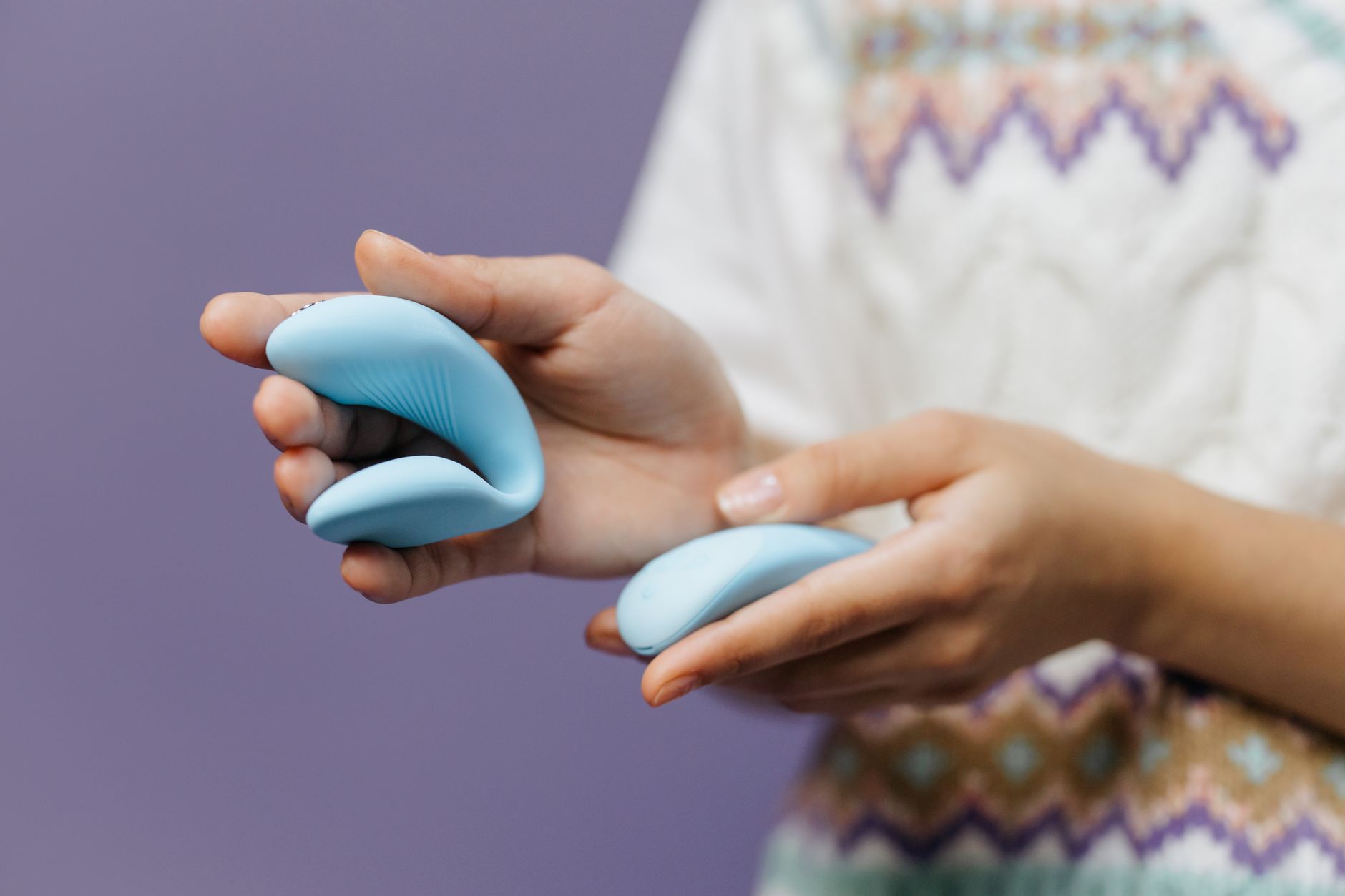
You have options. The Lem is a lemon clitoral vibrator with a suction mechanism that's gentler than traditional vibration. It's less intense than a wand vibrator, which means it's easier to use during partnered sex without overstimulation. There's no learning curve. Most people feel the difference immediately.
Wand vibrators are louder and more intense. They work, but they can feel overwhelming in partnership because the intensity is harder to modulate. Air-pulse vibrators like the Lem give you precision and control.
Buyers also sometimes ask about discreetness or noise. If your concern is noise, the Lem is quiet enough that you could use it in an adjacent room and no one would know. If your concern is discretion because you share space with housemates or family, again, a lemon suction vibrator is significantly quieter than a traditional vibrator.
Rhythm and feedback loop
One thing couples often get wrong is assuming the receiving partner should stay still and quiet. Actually, the opposite is true. Telling your partner "left a little, there, hold it" is the feedback loop that makes this work. Your partner isn't a mind reader. They don't know if the vibrator feels amazing or just okay. Give them information. Make noise. Move. Show them what feels good.
Similarly, if you're the partner holding the vibrator, watch and listen. Your partner's body will tell you when something is working. Faster breathing, hip movement, involuntary tensing, verbal cues. Pay attention. Adjust. This is where the real intimacy lives, not in the tool itself.
After the first time
You might feel weird about it. That's normal. You might also feel relieved and closer. Also normal. Some couples integrate vibrators into most of their sex. Others use them occasionally. Some get comfortable enough to try other things. The vibrator isn't a commitment to a new lifestyle. It's an experiment with a partner you trust.
If it doesn't work the first time, that's information too. Maybe the timing was off. Maybe you were anxious. Maybe you needed to be less self-conscious. Try again without pressure. This isn't a performance.
Many couples I've worked with tell me that introducing a vibrator together was actually a turning point for their sex life, not because the vibrator is magic, but because it forced a conversation they'd been avoiding. Once you can say "I want this to feel better" out loud, you can say other things too. Better sex usually follows better communication.
The vibrator isn't replacing your partner. It's giving both of you permission to want more.
FAQ: What people actually ask
Will using a vibrator together make my partner feel replaced?
No. Partners feel replaced when they're ignored or deprioritized. A vibrator is the opposite. You're saying "I want us to feel better together." That's an investment in the partnership, not a rejection of it. Most partners actually feel more secure once they see a vibrator works, because suddenly sex feels less like a performance and more like something you both enjoy.
How do I bring this up without sounding like I'm criticizing their technique?
Frame it as optimization, not repair. "I want our sex to feel better for both of us" is very different from "You're not doing this right." You're not criticizing. You're saying you want more pleasure, faster, with less effort. That's about desire, not dissatisfaction.
Can we use a vibrator during penetration without it being awkward?
Completely. One of you holds it against your clitoris while the other penetrates. It takes maybe 30 seconds to figure out the positioning. After that, it's just part of what you're doing. Awkwardness fades once you realize it actually works.
What if my partner says no to using a vibrator?
Ask why. Often it's a misunderstanding that clarifies quickly. "Does this mean you don't think I'm enough?" No, it means you want both of you to feel better. If they're still resistant after that conversation, give it time. Forcing it will backfire. Some partners come around once they see you're serious and relaxed about it. Some don't, and that's information about the relationship too.
How loud is a lemon vibrator, and will people hear us?
Lemon clitoral vibrators like the Lem are significantly quieter than traditional vibrators. You can use one in the same room as someone sleeping and they likely won't hear it. That said, if noise during sex is a concern, that's a separate conversation worth having with your partner.
Does my partner need to try the vibrator on themselves first?
It helps. Some partners feel more comfortable if they explore it solo before bringing it into partnered sex. Not required, but it takes the mystery out of the experience. Then when you use it together, everyone knows what to expect.